One model. Every layer of the application.
CEDM Platform is a modelling language, a library of business entities and a generator. Together they turn what you know about your business into software your teams can run, audit and extend.
A model people can read, and machines can check
The model is a YAML document: entities, value lists, lifecycles, rules, roles and reports. It is validated against a schema and a checker before anything is generated, and every finding points to its line and column.
- Import entities from the CEDM library by name, or declare your own
- Help text on every entity and field becomes the application's built-in help
- One checker for the command line, the modelling tool and the browser
cedm: "1.0"
application:
  name: Sales and Order Management
  domain: sales
imports:
  - module: common          # parties, places, currencies…
  - entity: Customer
  - entity: Quotation
  - entity: SalesOrder
  - entity: SalesOrderLine
ui:
  categories:
    - name: Sales
      icon: badge-dollar-sign
entities: [Customer, Quotation, SalesOrder]351 business entities you do not have to design
The CEDM library describes business entities in an implementation-neutral way: their fields, relationships, lifecycles, invariants and help. Applications import what they need, and everything an entity depends on comes with it.
- 541 governed value lists, each value with its own meaning
- Reference data from ISO 3166, 4217 and 639 and from GeoNames
- 55 domains catalogued, from finance to field service
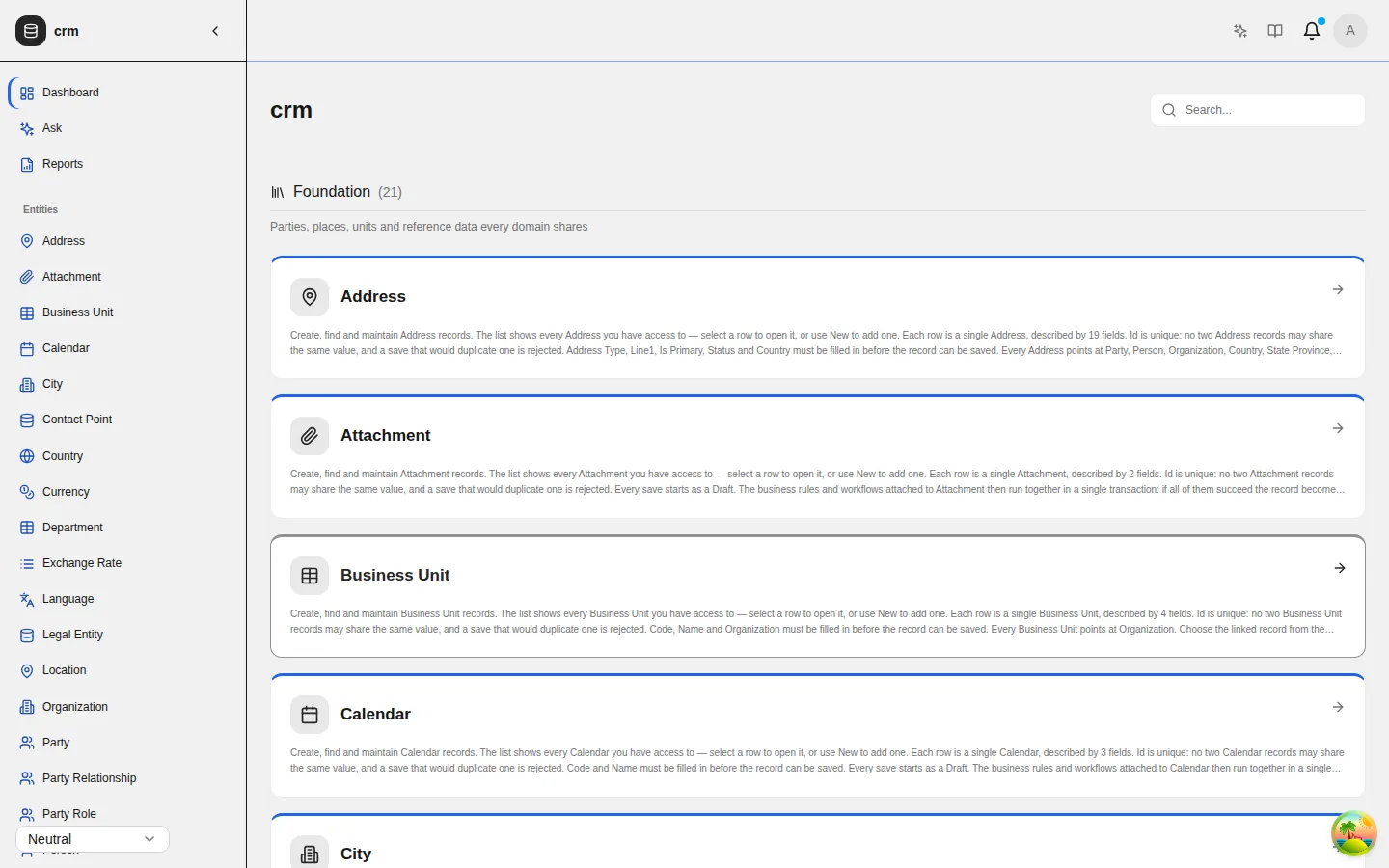
A complete application, as source code
Generation writes an ordinary project: a Cargo crate for the backend and Bun packages for the front end and tests. Your developers work in it with the tools they already know.
| Layer | Generated as | What it gives you |
|---|---|---|
| Database | PostgreSQL | Self-hosted, managed, or Neon serverless. Migrations and seed data are generated. |
| Backend | Rust on Loco.rs | Axum and SeaORM. One generic, dictionary-driven API serves every entity the model declares. |
| Web front end | TanStack Start and React 19 | Astryx components, seven themes switchable at run time, light and dark. |
| API | REST with OpenAPI | Self-describing at /openapi.json, browsable in Redoc and Scalar. |
| Logic | Rules, lifecycles, automations | GoRules decision tables, state machines with action buttons, and BPMN workflows. |
| Delivery | Docker and CI | Compose file, Dockerfiles and CI workflows generated alongside the code. |
| Quality | Generated test suites | Rust request suites, API suites, Playwright specs and a browser smoke test of every screen. |
| Assistance | A chat for your users | Find records, run reports and open the application's own screens from a conversation. |
Two generators that must agree, byte for byte
The generator exists twice, in TypeScript and in Rust, and the Rust one also runs as WebAssembly in a browser. On every change, all three generate the same backends from a corpus of models and must match exactly. A difference fails the build before it reaches anyone.
- Regeneration never deletes your code: hook handlers are written once and kept
- Lockfiles are generated, so a build that worked last week still works today
- Every generated backend is expected to compile cleanly with warnings treated as errors
No proprietary runtime in the way
A generated application is a standard Rust and TypeScript project on PostgreSQL. It runs on your infrastructure, behind your network policies, with your data in your database. The model ships inside the project, so the application always carries a readable statement of what it is.
- Runs anywhere Docker runs, or on a managed PostgreSQL such as Neon
- AI features use a model endpoint you choose, including local models
- Extend behaviour in Rust hook handlers around every create, update and delete
From a conversation to a reviewed model
Business analysts and developers work in one web tool, where the model is the shared artefact rather than a document that drifts from the code.
Start from a description
Describe the application in plain language. AI agents propose the entities and relationships, and a person approves the design before anything is generated.
See the model as a diagram
The modelling tool draws the YAML model as a laid-out diagram, so business and engineering review the same picture.
Design logic visually
One rules-and-workflows editor for decision tables, status machines, processes and automations, with a dry run against a sample record.
Every save is a version
Each project keeps its own Git history: drafts, named versions, restores and generations are all commits you can compare and roll back.
Bring the systems you already have
Most organisations are not starting from nothing. CEDM Platform reads existing systems into models, so modernisation starts from what is really there.
Compiere ERP, translated
All 411 business tables of Compiere ERP are translated into a CEDM model, split by functional area, and can be generated as a modern application.
Existing applications
A translator reads existing Java and Swing applications with ANTLR grammars and writes the same domain as a CEDM model.
Earlier model formats
Models written in the platform's earlier diagram notation translate construct for construct, with a report of anything that needs a decision.
See it build your application
Bring a process you run today. We will model it with you and generate the application in the same session.